I am passionate about helping people change their minds.
That may sound like I want to persuade people to agree with me. I don’t. I mean something more intimate and often more difficult: helping us discover that the belief we have been living within isn’t the only landscape available to us.
I have always loved this old-fashioned word metanoia: a profound change of mind or heart. I love the possibilities it opens up, but I also know how painful such a change can be.
I know because I have been through it firsthand.
For years, I found meaning and belonging in metaphysical and spiritual communities. Then I watched troubling ideas begin to circulate within those communities. Claims gained force through repetition, and questioning them came to be seen as disloyalty. I began to see how readily a search for insight could drift into suspicion, propaganda, and a story in which someone always had to be the enemy.
I wanted to understand what was happening, so I kept digging deeper until it became hard to step back. I had to examine ideas I trusted and relationships I valued. I wondered whether I could ever be curious again. How could I remain open to wonder without surrendering my discernment? For a while, I had to live without the certainty that had once made the world feel easier to explain.
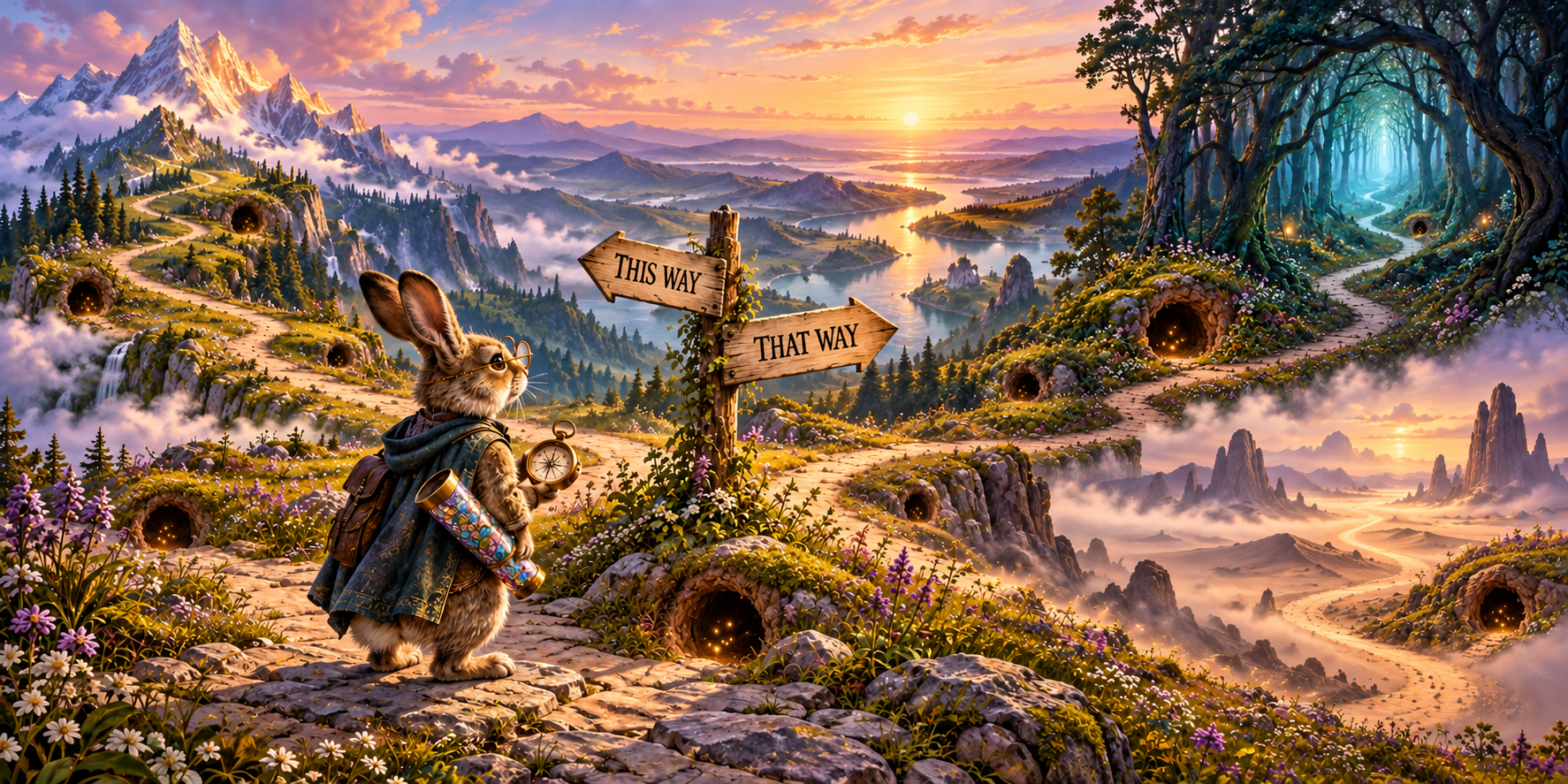
with a compass and kaleidoscope our Curator is ready to guide us
That experience helped spark What’s Up with Rabbit Holes? An Insider’s Guide to Investigating What We Believe, Why We Believe It, and What We Might Be Missing. The book began as an exploration of others’ rabbit holes and became an invitation to investigate our own. When we are willing to look at what draws us in, what keeps us there, and what makes it hard to leave, we begin to see the landscape of our personal and collective consciousness more clearly.
That willingness matters to me more than ever as I watch propaganda exploit our natural hunger for meaning and belonging. I am concerned about a growing number of political and spiritual movements, including authoritarianism and Christian nationalism, that teach people to distrust every source of authority except their own. When leaders and organizations treat questioning as betrayal of the group, they narrow what their followers are free to see and speak about. Their claims are repeated in speeches and videos, amplified by algorithms, until brothers, neighbors, and allies begin to look like threats. To me, that is one of the cruelest distortions of our values: the pursuit of power dressed in the language of protection and faith.
Even as I name what concerns me, I do not want to assume I understand everyone drawn to these movements or why they believe what they do. I want to practice asking what this belief is doing to my psyche. What are the fruits of believing in this version of reality? What does it help me see, and what might it prevent me from seeing? Who benefits when I become too frightened or too invested to reconsider it? What happens when I become more concerned with defending my belief and insisting I am right than with considering what I might be missing? And what happens to my compassion when I hold on to it?
Leaving one account of the world can feel like losing the world itself. I understand why someone might hesitate at the edge of that change. The grief, embarrassment, anger, and frightening sense of having no firm ground can feel insurmountable.
I had to consciously decide to step away from a worldview shaped by paranoia, where suspicion seemed wiser than trust, and someone always had to be the enemy. I wanted to make room for pronoia again—for the possibility that goodness, help, and hope were still present, even when I could not see what would happen next. My metaphysical and recovery teachings taught me to take what I need and leave the rest. I want to actively help create the kind of world I want to live in. I did not then, and do not now, want to accept a vision of human life in which cruelty and destruction are inevitable, or in which hatred, greed, injustice, and oppression pass for clear sight.
I still struggle to hold on to a view of the world grounded in another of my favorite old-fashioned words, meliorism: the conviction that the world can become better through our participation. That’s why I created the Twelve+ Codes for Be~coming: to give us ways to participate in that possibility and help us become better, brighter, and wiser—on purpose and with purpose. These tools help maintain the decision to live in a world of hope, wonder, and joy. I want to continually renew my belief that people can learn, repair harm, and make better choices. More than that, I need to help make those possibilities real.
A melioristic worldview makes room for metanoia, even when changing our minds is painful. Its hope is modest in one sense: it promises no perfect future and no final set of answers, only new landscapes to navigate. Yet it asks a great deal of us. It asks us to pay attention, look again, tell the truth as carefully as we can, and remain capable of changing course.
I wrote What’s Up with Rabbit Holes? for those of us drawn into compelling worldviews that offered community and answers, only to find that, over time, they became increasingly narrow, with less room for compassion, inclusivity, and questioning authority. I wrote it to share my experience, strength, and hope, along with the questions that have helped me navigate my own consciousness: How did I come to know this? What might I be missing? What does this belief give me the right to claim, or to pass on to someone else?
Changing our minds can hurt. We may feel embarrassed—or even humiliated—by what we believed, defended, or passed on to others. Yet reconsidering can reveal landscapes we could not see from where we stood before. In my experience, some of those landscapes offer beauty, connection, and hope I could not have imagined, even as I was afraid to look again.
If you or someone you love is standing at the edge of such a change, I hope the book keeps you company as you investigate what you believe and what you might be missing. After all, we don’t have to know what a new landscape will reveal to be willing to look toward it. We can be uncertain, even afraid, and still step beyond what we thought we knew, with our questions, compass, kaleidoscope, and the Curator’s invitation to guide us.
Let’s look again.