


Well, the rabbit has officially taken the podium!
My new book, What’s Up with Rabbit Holes?, is now available in paperback.
The full title is:
What’s Up with Rabbit Holes?
An Insider’s Guide to Investigating What We Believe, Why We Believe It, and What We Might Be Missing
Almost everyone has heard the term rabbit hole and has some idea of what it means. So when I first began playing with the title What’s Up with Rabbit Holes?, I couldn’t help hearing an echo of Bugs Bunny’s famous, “What’s up, Doc?” So I almost dismissed it! But as the book developed, I realized that “What’s up?” was doing much more work than I had originally intended. In fact, it is one of the central questions of the entire book.
What is up with rabbit holes? Why do we enter them? What keeps us there? When do they open our minds—and when do they narrow our field of vision? How do we know when curiosity has turned into certainty? And perhaps most importantly: Are we willing to question what we think we know—even what we think we know about rabbit holes themselves? That is really the premise of the book. It’s not: Let’s identify who has fallen down the wrong rabbit hole. But rather: Let’s investigate how all of us come to believe what we believe, why we hold onto them, and what we might still be missing.
The subtitle grew so organically out of the writing that it practically wrote itself. Every part of it matters, but the word “Insider” became especially important to me, because this is not a book written from outside the rabbit hole, pointing at the people who are inside one. It is an Insider’s Guide, because I have been in plenty of them myself, and because applying the Twelve+ Codes for Be~coming to my own worldview eventually made me part of my own investigation.
Spiritual rabbit holes. Metaphysical rabbit holes. Psychological rabbit holes. Cultural rabbit holes. Alternative-health rabbit holes. Political rabbit holes. Fascinating rabbit holes. Productive rabbit holes. Ridiculous rabbit holes. Some opened my mind, some narrowed it. And some were so confusing it took years to discern what was up. However, I discovered:
Rabbit Holes Aren’t the Problem
Being curious is not the problem; neither is questioning conventional wisdom or authority. The exploration of unconventional possibilities is not the problem. Human beings have always learned by wandering beyond the boundaries of what everyone already knows.
The problem begins when exploration quietly turns into certainty; when a possibility becomes an explanation; when an explanation becomes a worldview; when a worldview becomes an identity; and when identity begins deciding which evidence we are willing to see. Without our awareness, when we’re underground, our field of vision narrows. That is why I became increasingly interested not simply in what people believe, but in the architecture of believing itself.
Where did this belief come from?
What supports it?
What contradicts it?
What emotional need might it satisfy?
What community reinforces it?
What happens when someone questions it?
And perhaps most importantly:
What are the fruits of believing it?
The Investigation Turned Around
At some point during the writing of this book, I realized I could no longer investigate other people’s certainty without investigating my own. That was inconvenient, but it turned out to be enormously useful. For most of my adult life, I have been deeply interested in spirituality, consciousness, healing, metaphysics, extraordinary human potential, and ideas that exist well outside conventional boundaries.
And I am happy to report that I still am. Writing this book did not change that, but I have become much more careful about distinguishing between:
what I believe,
what I know,
what I suspect,
what I hope is true,
and what the available evidence entitles me to claim.
That distinction has become increasingly important to me, because our beliefs do not remain private. We transmit and teach them. We recommend books, products, teachers, treatments, explanations, movements, philosophies, and entire ways of interpreting reality. I have learned that conviction and sincerity alone do not make a claim true, and sometimes misinformation that appears dishonest is simply sincerity that has outrun the evidence.
When my writing turned into self-investigation and brought me to the Code of Communication, I had to ask myself: What do my beliefs give me the right to transmit? That question changed how I think about my responsibility as an author, teacher, psychotherapist, and fellow human being. I’ll be exploring much more of this on my TTN podcast, The Power of Beliefs: Do We Own Them? Or Do They Own Us?, on Wednesday, September 9th at 3:30 PM ET.
There Is Only More Landscape
I wish I could tell you that somewhere at the end of these investigations there is a final rabbit hole containing The Answer. I checked, and rechecked. Apparently, there isn’t even a mountaintop where the perfectly discerning gather to congratulate one another for finally seeing reality correctly.
There is only more landscape. And with more landscape comes more evidence, more perspectives, more mystery, and more opportunities to discover that what we thought was the whole picture was only one turn of the kaleidoscope.
Strangely enough, I find that encouraging. Because the goal was never to stop researching or believing. The goal is to become more conscious of how we research, how we know, how we come to believe, and to intentionally develop the capacities that help us do all this more wisely.
That is where the Twelve+ Codes for Be~coming come in. They help us remain capable of learning and changing, and of holding convictions without becoming imprisoned by them. We learn to explore without surrendering our judgment; to stay open to complexity, competing evidence, and perspectives that challenge our own. With the Code of Consideration, we discover that we can reconsider without repudiation. And the Code of Communication has helped me become more responsible for what I transmit into the future I want to help create.
Enter the Curator
You may have met him in a previous blog or newsletter, as he plays a major role in the book. He is an adorable bespectacled rabbit who has an uncanny knack for appearing whenever certainty becomes a little too comfortable; in other words, when we start thinking we know everything there is to know about this, that, or the other thing.
He does not tell us what to believe. He obviously cannot forbid rabbit holes; that would be rather awkward for a rabbit. And I learned firsthand that he does not confiscate our metaphysics, our mysteries, our unconventional questions, or our favorite theories.
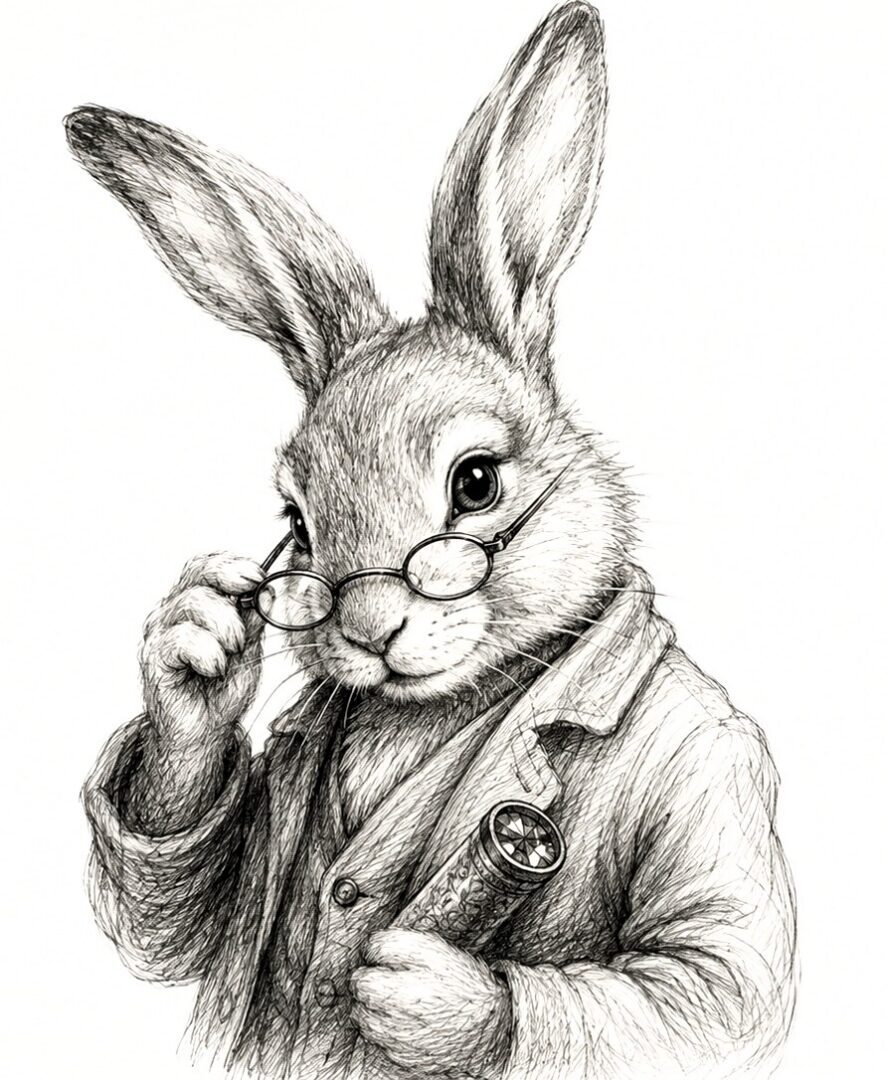
He simply peers over his spectacles and asks us to do something surprisingly difficult:
Look again.